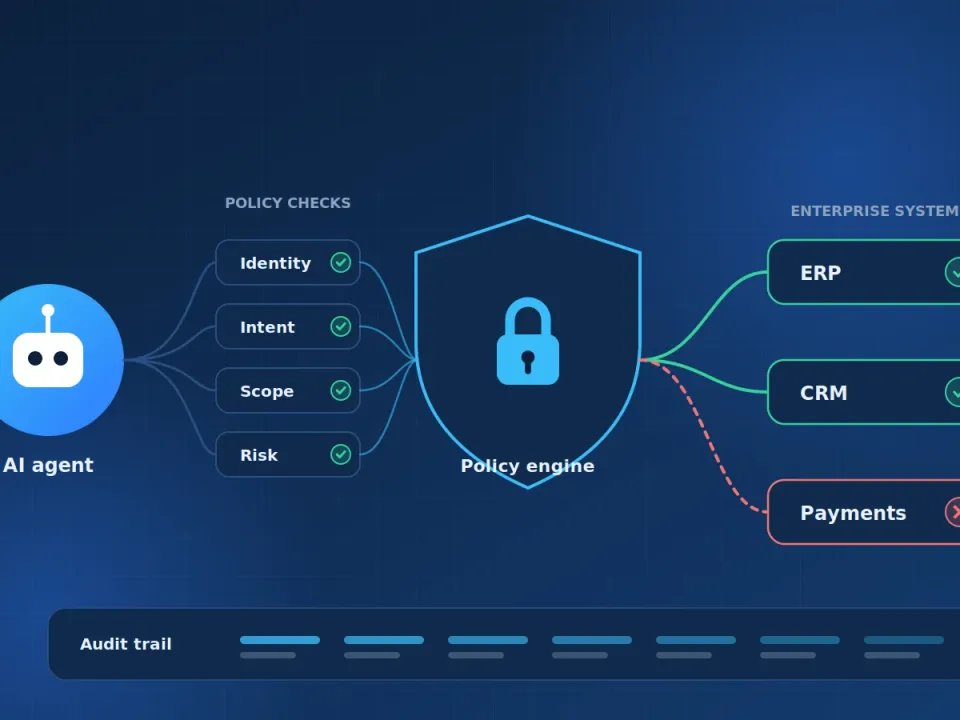
From intelligent ideas to production-ready systems. Organizations need more than disconnected AI tools, isolated applications, and short-lived technology experiments. They need systems that connect intelligence to enterprise data, business workflows, existing platforms, and operational decisions.
Fragmented technology
Legacy platforms, siloed data, duplicated services, and tightly coupled applications make change expensive and slow.
Identify the architectural constraints
A practical path toward integration and modernization
Organizations often have the data, applications, and business rules needed to solve a problem, but those resources sit in systems that do not work together. An AI-native workflow platform connects them through a governed execution layer, so AI can interpret context, support decisions, invoke approved tools, and coordinate the process.
Enterprise data access
Controlled APIs and retrieval services, so the system sees information it is allowed to use.
Model orchestration
Model selection and task routing matched to the work, the latency, and the quality you need.
Workflow runtime
Durable state, retries, timeouts, and recovery, instead of a call that forgets where it stopped.
Policy and approved tools
Identity, authorization, risk-based approval, and adapters that can only take actions you have allowed.
A reference architecture for discussion and solution design. Components, deployment, and security controls depend on the customer's requirements.
We approach every engagement with a clear objective: understand the problem, design the right solution, establish sound engineering foundations, and define how success will be measured. The technology may be AI, cloud, data, embedded software, or enterprise integration. The solution has to work where the business actually operates.
01
Discover and assess
The objective, the current environment, the stakeholders, the constraints, and the risks.
02
Architect and prioritize
Options, system boundaries, integration, security, and a target architecture with a roadmap.
03
Validate
Test the highest-risk assumptions on representative data, workloads, and constraints.
04
Engineer and integrate
Build the agreed parts, connect what you already run, and leave tests and operational visibility.
05
Measure and improve
Judge the result against the acceptance criteria, then leave monitoring, ownership, and the next improvements.
Responsible execution
Security, governance, and accountability belong in the design. A prompt that tells a model not to do something is not a control.
Identity and access
Role-based and attribute-based access, with tool permissions enforced outside the model.
Human authorization
Sensitive operations can require another check or a person's approval, bound to that specific action.
Untrusted input
Prompt injection and untrusted input are treated as design concerns, with a threat model for the use case.
Evidence
Audit trails, evaluation, and runtime monitoring show what ran, what was denied, and what changed.
Technologies and approaches to consider
Chosen for the problem. The list is a landscape, not a claim that every engagement uses every tool.
Foundation models
Model routing
Embeddings
RAG
Evaluation pipelines
Workflow orchestration
Tool calling
MCP
A2A
Durable execution
RBAC
ABAC
OAuth 2.0
OpenID Connect
Policy enforcement
AWS
Azure
Google Cloud
Docker
Kubernetes
Infrastructure as Code
REST
gRPC
Event-driven messaging
API gateways
Schema management
SQL
Streaming
Data quality
Lineage
Vector retrieval
Hybrid search
OpenTelemetry
Distributed tracing
Metrics
Structured logs
Evaluation telemetry
C++
Python
Java
C#
Linux
CI/CD
Automated testing
Least privilege
Threat modeling
Timeouts
Idempotency
Recovery testing
AI and LLM engineering
Foundation models · Model routing · Embeddings · RAG · Evaluation pipelines