
Services
AI governance, security, and operational control
Establish explicit controls around AI-enabled workflows and support accountable deployment.
We help organizations reason about how AI systems access information, interact with tools, perform actions, and remain accountable throughout execution.
The agent can reason and recommend. The platform should own authorization, execution controls, durable workflow state, and the evidence needed to establish what actually happened.
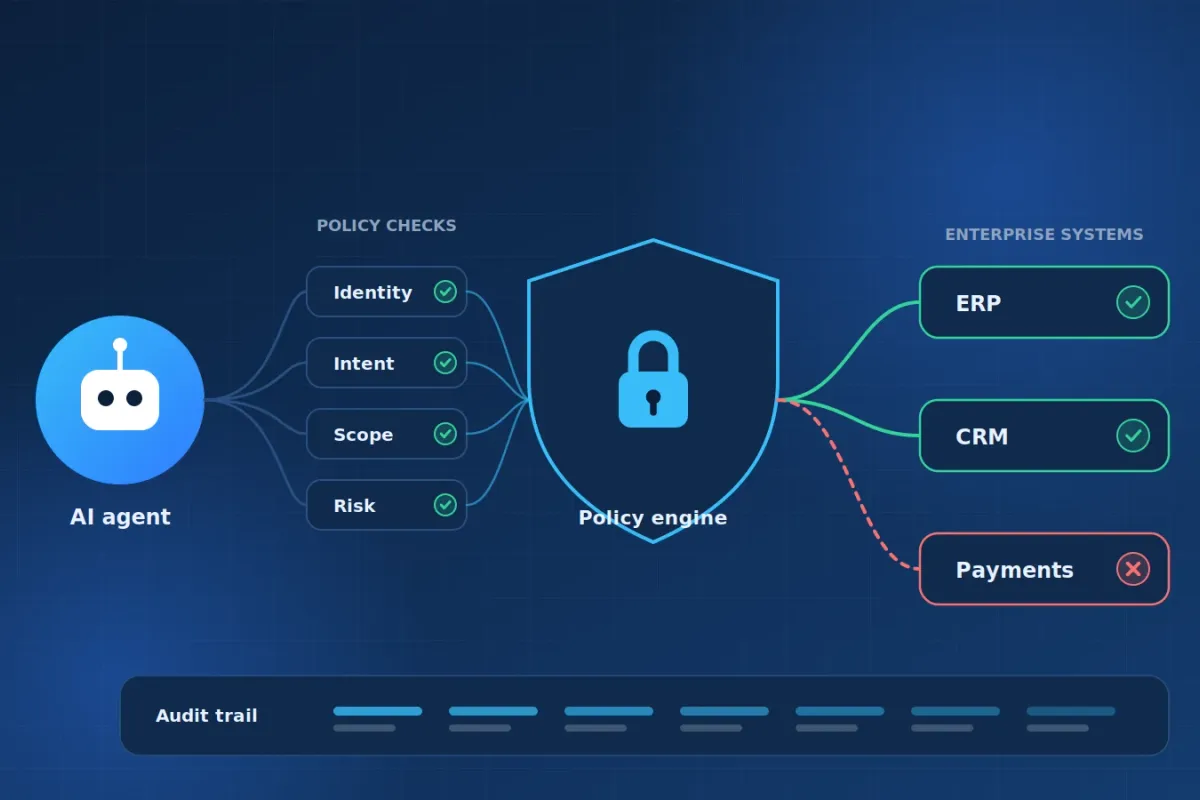
What you get
- AI risk assessment and governance architecture
- Role-based and attribute-based access control
- Tool permissions and policy enforcement
- Human authorization for sensitive operations
- Prompt-injection and untrusted-input threat modeling
- Audit trails, evaluation, and runtime monitoring
Where it helps
Decide which actions a system may take
Enforce tool permissions outside the model
Send a sensitive operation to a person
Keep an audit of what was allowed and what changed
Technologies
- RBAC
- ABAC
- OAuth 2.0
- OpenID Connect
- Policy enforcement
How an engagement runs
01
Name the risk
Which information the system can reach, which tools it can call, and which actions would matter if they were wrong.
02
Put authority outside the model
Identity, policy, and an execution gateway that validates the request before anything changes.
03
Add approval where it counts
Sensitive or exceptional operations go to an authorized person, bound to the specific action.
04
Keep the evidence
Policy outcomes, tool invocations, and state changes, without storing secrets or needless confidential prompts.
Questions
- How do you approach AI security and governance?
- Security should be designed into identity, data access, tool permissions, execution controls, evaluation, and monitoring. Sensitive operations may require additional verification or human approval. The controls should reflect the use case, threat model, and applicable obligations.
- Can a prompt be the security boundary?
- No. The enforcement layer must be authoritative. A prompt instructing an agent not to perform a prohibited operation is not a substitute for a technical control that prevents the operation.
- What should an audit record contain?
- Policy outcomes, tool invocations, execution results, relevant identifiers, and state transitions. Sensitive content should be minimized, access-controlled, and retained according to the organization's policies.
- How do you measure success?
- We establish baseline measurements and agreed acceptance criteria. Depending on the project, these may include accuracy, processing time, latency, error rates, operational cost, manual intervention, workflow completion, or other business-specific outcomes.